Anzac,
Vimy Ridge, Monash and the education of children
metadata removed
end of
.post-meta
Chris
Watters*
Towards the end of the 20th
century there was an increase in claims that battles fought in World War I
defined national identity [T1] in Australia and Canada. between
These claims sounded similar, despite the differences in history the two
countries.
Into the
beginning of the 21st century this narrative is becoming louder, more
orchestrated and nearly identical in content. These claims presuppose that
there was no significant national identity in either country prior to the World
War I battles; accordingly, they militarise national history at the expense of
political, social and civil developments in each society.
On 25 April
2012, the then Australian Prime Minister, Julia Gillard, gave a speech at a
Gallipoli commemoration ceremony in Turkey. She claimed that the Gallipoli
landings were ‘our first act of nationhood in the eyes of a watching world, an
act authored not by statesmen or diplomats, but by simple soldiers. The Anzacs.
The boys of Federation who became the men of Gallipoli.’ (1; footnotes to this
article are here) The Prime
Minister then quoted the words of Charles Bean that it was at Anzac that ‘the
consciousness of Australian nationhood was born’[T2] . She added: ‘The laws and
institutions of our nation were laid down in 1901. But here, in 1915, its
spirit and ethos were sealed.’
In 2007,
the Canadian Prime Minister, Stephen Harper, gave a speech at the anniversary
of Canada’s iconic World War I battle at Vimy Ridge, France, in April, 1917.
‘Every nation’, he said, ‘has a creation story. [T3] The First World War and the
battle of Vimy Ridge are central to the story of Canada.’ (2) The Prime
Minister agreed with Brigadier-General AE Ross, a witness to the battle, who
said after the war, ‘Canada
from the Atlantic to the Pacific on parade, I felt that I was witnessing the
birth of a nation’[T4] . (Canada had been a dominion,
equivalent to the Australian colonies federating, since 1867.)
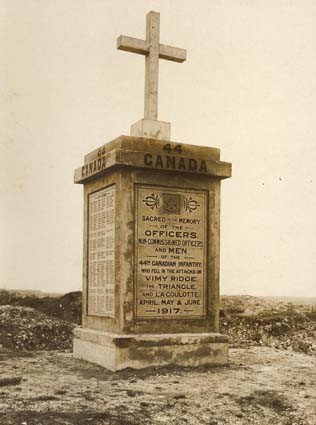
War memorial to the officers,
non-commissioned officers and men of the 44th Canadian Infantry who fell in
attacks on Vimy Ridge, the Triangle and La-Coulotte during April, May and June
1917 (source: National Archives of Australia, M5107, 8363910; photo: RV Morse)
On a battlefield where 3598
Canadians died, Prime Minister Harper also said that ‘there may be no place on
earth that makes us feel more Canadian’. In similar vein, Australian Prime
Minister, John Howard, said in 2004 of Gallipoli (8141 deaths, according to the
Australian War Memorial), [T5] ‘You feel as an Australian it’s
as much a part of Australia as the land on which your home is built’. (3)
While the rhetoric decades later
was the same in Australia and Canada, the original events were very different.
The Gallipoli campaign was a nine month disaster; Vimy Ridge was a successful
three day battle which dislodged the Germans from a very strategic ridge. [T6] The Anzacs did not undergo
rigorous amphibious training to prepare for their assault and did not know
their individual place in the campaign; the Canadians rehearsed tirelessly for
months and even Sergeants and Corporals were shown exactly where they fitted
into the overall plan.[T7]
Prime
ministerial rhetoric in both countries has been reflected at many levels, for
example, in education programs. All Australian States and Territories in
Australia now have Anzac student awards in some form; the winners travel on a
chaperoned tour of the battlefields of Europe. One winning essay says, ‘The ANZAC’s gave
my generation freedom and the choice[T8] , to do whatever we want to do
with our lives. No longer is there a set plan for men and women in society. Women are
welcomed at universities to increase their chances of securing high paid jobs[T9] , rather than childbearing and
homemaking.’ This winner wiped from history the pre-World War I struggle for
universal suffrage and equality in Australia.
In Canada,
the comparable children’s tour is conducted through the Beaverbrook Vimy Prize.
The entries are kept confidential. (4) In 2007, 3600 Canadian school children made the
pilgrimage to the site in France and wore replica uniforms labelled with the
names of fallen soldiers. [T10] Many Canadian students spend their gap year as tour guides at the Vimy
battlefield.
Despite the
views of some commentators, the idea that Australia already possessed a proud
democratic identity when World War I started is not an example of the black
arm-banded left rewriting history. [T11] General Monash himself wrote that Australians had a strong national
identity prior to the war and, given the strong link between war commemoration
and the education of children in today’s Australia, it is interesting to note
that Monash also thought the education system of the day was an important
contributor to the quality of the troops he led. He attributed any uniqueness
of the Australian soldier to ‘[t]he democratic institutions under which he was
reared, the advanced system of education by which he was trained – teaching him
to think for himself and to apply what he had been taught to practical ends’.
(5)
It is a
constant and clear theme in the literature that pre-World War I Australian
governments went to great lengths to achieve high education standards and to
ensure they were available to as many children as possible. (6) The state
provided free transport to school and subsidised the cost of a tutor if the
home was too far from a school. A high level of civic pride was shown by the
fact that state schools and books were free and that the curriculum was
designed to be ‘alive and interesting’. (7)
The result
of this educational framework was said to be that, ‘[n]aturally, Australian
children get to like school’. (8) Monash also wrote that the Australian soldier
had a high sense of teamwork ‘learnt from the sporting field, in his industrial
organisations and in his political activities’[T12] . (9) The positive correlation in citizens between sporting prowess and
soldering is always highlighted. (On the other hand, the fact that Monash
thought that he commanded better soldiers because they were politically active or
unionised in civilian life is never mentioned.)
The battles
at Gallipoli and Vimy Ridge were starkly different in many ways; however, they
are commemorated similarly in Australia and Canada. Both Canada and Australia
have used their respective battles as a basis to forge their identity as a
nation, and neither battlefield success (or lack of it) nor other strategic
detail appear to have impacted on the way the battles have been interpreted.
National
myths can be beneficial to a nation. They can foster unity, define social
values and construct a sense of identity. Yet the blind veneration of the
soldier, coexisting in rituals in secular yet holy ground, suggest an appeal
towards emotions over reason. This [T13] could create a self-fulfilling prophecy by improving the overall quality
of Australian and Canadian soldiers, as modern day volunteers would want to
enhance and uphold the legend, or, in the event that conscription were to be
reintroduced in Australia and Canada, the mythology of Anzac and Vimy could be
a useful psychological primer for recruits.
Myths can
suggest which values citizens of a society should and should not adhere to. But
values can grow from other sources, too. Since World War I there have been unprecedented
advances in all the disciplines of science, from physics to sociology[T14] . These are the disciplines in which the children of today should be
educated. Human, gender, indigenous and minority rights have progressed rapidly
also and one would hope they benefit all children and youths equally.
It is surely possible that
another event can be found to symbolise the birth of a nation in both Australia
and Canada, one that does not involve fighting a war, now associated with
futility, nearly a century ago. [T15] National narratives are powerful forces and it could be beneficial to
create one which is based on enlightenment and not destruction, one that
encourages the children of today to look forward to a humane and productive
future, rather than backward to imagined glories on the battlefield.
[T1]
Challenge, Some people like me suggest that national identity is formed during
wars, especially WW1 because, Australian soldiers really fought for there lives
bringing out new identities.
[T4]Extend,
Are Canadians thinking what we are, born fighters?, What about their day like
our Australia day, is it being taken over too?
[T5]Challenge,
So we aren’t the only country thinking Gallipoli made us, why do we spend the
most on Anzac day, many other countries are feeling the same.
[T13]Challenge, they also can give you false hope or false
advice, that could do bad for your country.
[T14]Connection,
so maybe we are not picking up on other factors that influenced are identity,
not just fighting.
[T15]Extend,
we think of big changing events that seem to always involve death what about
other non violent events?


